
Skip to content
  • About
    • About the project
    • Guidance
  • Climate Disinformation
    • Modules
    • Disinformation Narratives
    • Bi-annual reports
  • Media Literacy
    • Modules
    • Articles
    • Graphics & Videos
    • External Material
  • Resources
  • About
    • About the project
    • Guidance
  • Climate Disinformation
    • Modules
    • Disinformation Narratives
    • Bi-annual reports
  • Media Literacy
    • Modules
    • Articles
    • Graphics & Videos
    • External Material
  • Resources
  • About the project
  • Climate Disinformation
  • Modules
  • Contact
  • About the project
  • Climate Disinformation
  • Modules
  • Contact
  • About
    • About the project
    • Guidance
  • Climate Disinformation
    • Modules
    • Disinformation Narratives
    • Bi-annual reports
  • Media Literacy
    • Modules
    • Articles
    • Graphics & Videos
    • External Material
  • Resources
  • About
    • About the project
    • Guidance
  • Climate Disinformation
    • Modules
    • Disinformation Narratives
    • Bi-annual reports
  • Media Literacy
    • Modules
    • Articles
    • Graphics & Videos
    • External Material
  • Resources
Search
  • Home
  • All Courses
  • Media Literacy

Critical Thinking Skills / Fallacies

Curriculum

  • 5 Sections
  • 28 Lessons
  • 25 Minutes
Expand all sectionsCollapse all sections
  • Introduction
    1
    • 1.1
      Introduction
  • Learning objectives
    1
    • 2.1
      Learning objectives
  • Fallacy literacy training
    15
    • 3.1
      Fallacy literacy training 1/15
    • 3.2
      Fallacy literacy training 2/15
    • 3.3
      Fallacy literacy training 3/15
    • 3.4
      Fallacy literacy training 4/15
    • 3.5
      Fallacy literacy training 5/15
    • 3.6
      Fallacy literacy training 6/15
    • 3.7
      Fallacy literacy training 7/15
    • 3.8
      Fallacy literacy training 8/15
    • 3.9
      Fallacy literacy training 9/15
    • 3.10
      Fallacy literacy training 10/15
    • 3.11
      Fallacy literacy training 11/15
    • 3.12
      Fallacy literacy training 12/15
    • 3.13
      Fallacy literacy training 13/15
    • 3.14
      Fallacy literacy training 14/15
    • 3.15
      Fallacy literacy training 15/15
  • Critical thinking skills: The 5 techniques of sciences denial by John Cook
    11
    • 4.1
      Critical thinking skills: The 5 techniques of sciences denial by John Cook 1/10
    • 4.2
      Critical thinking skills: The 5 techniques of sciences denial by John Cook 2/10
    • 4.3
      Critical thinking skills: The 5 techniques of sciences denial by John Cook 3/10
    • 4.4
      Critical thinking skills: The 5 techniques of sciences denial by John Cook 4/10
    • 4.5
      Critical thinking skills: The 5 techniques of sciences denial by John Cook 5/10
    • 4.6
      Critical thinking skills: The 5 techniques of sciences denial by John Cook 6/10
    • 4.7
      Critical thinking skills: The 5 techniques of sciences denial by John Cook 7/10
    • 4.8
      Critical thinking skills: The 5 techniques of sciences denial by John Cook 8/10
    • 4.9
      Critical thinking skills: The 5 techniques of sciences denial by John Cook 9/10
    • 4.10
      Critical thinking skills: The 5 techniques of sciences denial by John Cook 10/10
    • 4.11
      Critical thinking skills: The 5 techniques of sciences denial by John Cook Quiz
      7 Questions
  • Resources
    1
    • 5.1
      Resources

Critical thinking skills: The 5 techniques of sciences denial by John Cook 9/10

  1. Conspiracy theories

The conspiracy phenomenon is very complex, not only does it shy away from scientifically proven information but it connects events worldwide and connects them to a single explanation sometimes involving fallacious reasoning. It is part of the FLICC strategies of science denial from John Cook. Despite its complexity, some characteristics can be identified. These include:

  • Alleged ‘evidence’ that appears to support the conspiracy theory, but which is often based on connecting unrelated facts and has been repeatedly disproved by a large number of reliable sources.
  • Circular reasoning: nothing is accidental, both evidence against the conspiracy and lack of evidence are interpreted as evidence for its truth.
  • They divide society into camps: the good guys and the bad guys.[1]
  • Conspiracy theories

[1] Based on: https://www.logicallyfallacious.com/logicalfallacies/Conspiracy-Theory and

https://desfake.cat/ (Capsule 4)
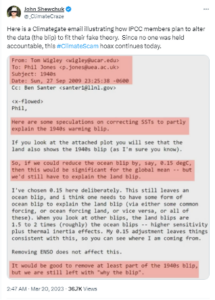
https://x.com/_ClimateCraze/status/1637631843548667907

Conspiracy theories
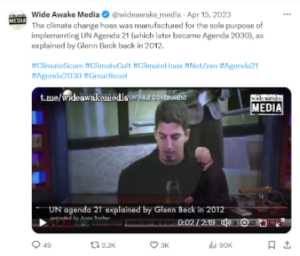
https://x.com/search?q=conspiracy+global+warming&src=typed_query

Critical thinking skills: The 5 techniques of sciences denial by John Cook 8/10
Prev
Critical thinking skills: The 5 techniques of sciences denial by John Cook 10/10
Next

coordinated by

CMCC – Fondazione Centro Euro – Mediterraneo sui Cambiamenti Climatici

Via Marco Biagi 5 – 73100 Lecce, Italy
Tel: +39 0832 1902411
© 2024 Agora. All rights reserved
Facebook X-twitter Linkedin Youtube Envelope

coordinated by

CMCC – Fondazione Centro Euro – Mediterraneo sui Cambiamenti Climatici

Via Marco Biagi 5 – 73100 Lecce, Italy
Tel: +39 0832 1902411
© 2024 Adaptation AGORA. All rights reserved
Facebook X-twitter Linkedin Youtube Envelope

Funded by the European Union. Views and opinions expressed are however those of the authors only and do not necessarily reflect those of the European Union or the European Commission. Neither the European Union nor the granting authority can be held responsible for them.

  • Terms of Use
  • Privacy Policy
  • Cookie Declaration

Funded by the European Union. Views and opinions expressed are however those of the authors only and do not necessarily reflect those of the European Union or the European Commission. Neither the European Union nor the granting authority can be held responsible for them.

  • Terms of Use
  • Privacy Policy
  • Cookie Declaration