
Skip to content
  • About
    • About the project
    • Guidance
  • Climate Disinformation
    • Modules
    • Disinformation Narratives
    • Bi-annual reports
  • Media Literacy
    • Modules
    • Articles
    • Graphics & Videos
    • External Material
  • Resources
  • About
    • About the project
    • Guidance
  • Climate Disinformation
    • Modules
    • Disinformation Narratives
    • Bi-annual reports
  • Media Literacy
    • Modules
    • Articles
    • Graphics & Videos
    • External Material
  • Resources
  • About the project
  • Climate Disinformation
  • Modules
  • Contact
  • About the project
  • Climate Disinformation
  • Modules
  • Contact
  • About
    • About the project
    • Guidance
  • Climate Disinformation
    • Modules
    • Disinformation Narratives
    • Bi-annual reports
  • Media Literacy
    • Modules
    • Articles
    • Graphics & Videos
    • External Material
  • Resources
  • About
    • About the project
    • Guidance
  • Climate Disinformation
    • Modules
    • Disinformation Narratives
    • Bi-annual reports
  • Media Literacy
    • Modules
    • Articles
    • Graphics & Videos
    • External Material
  • Resources
Search
  • Home
  • All Courses
  • Climate Change
  • Understanding Climate Change

Understanding Climate Change

Curriculum

  • 11 Sections
  • 32 Lessons
  • 25 Minutes
Expand all sectionsCollapse all sections
  • Introduction
    1
    • 1.0
      Introduction
  • What is climate
    4
    • 2.0
      What is climate 1/4
    • 2.1
      What is climate 2/4
    • 2.2
      What is climate 3/4
    • 2.3
      What is climate 4/4
  • How can climate models benefit you
    3
    • 3.0
      How can climate models benefit you 1/3
    • 3.1
      How can climate models benefit you 2/3
    • 3.2
      How can climate models benefit you 3/3
  • How to use and visualize climate data?
    4
    • 4.0
      How to use and visualize climate data? 1/4
    • 4.1
      How to use and visualize climate data? 2/4
    • 4.2
      How to use and visualize climate data? 3/4
    • 4.3
      How to use and visualize climate data? 4/4
  • Quiz
    1
    • 5.0
      How to use and visualize climate data? Quiz
      3 Questions
  • Climate threats and hazards
    3
    • 6.0
      Climate threats and hazards 1/3
    • 6.1
      Climate threats and hazards 2/3
    • 6.2
      Climate threats and hazards 3/3
  • Climate risks
    3
    • 7.0
      Climate risks 1/3
    • 7.1
      Climate risks 2/3
    • 7.2
      Climate risks 3/3
  • How can societies respond to the impacts of climate change?
    5
    • 8.0
      How can societies respond to the impacts of climate change? 1/4
    • 8.1
      How can societies respond to the impacts of climate change? 2/4
    • 8.2
      How can societies respond to the impacts of climate change? 3/4
    • 8.3
      How can societies respond to the impacts of climate change? 4/4
    • 8.4
      How can societies respond to the impacts of climate change? Quiz
      3 Questions
  • Climate justice and citizens’ participation
    3
    • 9.0
      Climate justice and citizens’ participation 1/3
    • 9.1
      Climate justice and citizens’ participation 2/3
    • 9.2
      Climate justice and citizens’ participation 3/3
  • Food and climate
    3
    • 10.0
      Food and climate 1/3
    • 10.1
      Food and climate 2/3
    • 10.2
      Food and climate 3/3
  • New frontiers
    5
    • 11.0
      New frontiers 1/4
    • 11.1
      New frontiers 2/4
    • 11.2
      New frontiers 3/4
    • 11.3
      New frontiers 4/4
    • 11.4
      New frontiers Quiz
      3 Questions

How can societies respond to the impacts of climate change? 4/4

Types of adaptation 2/2

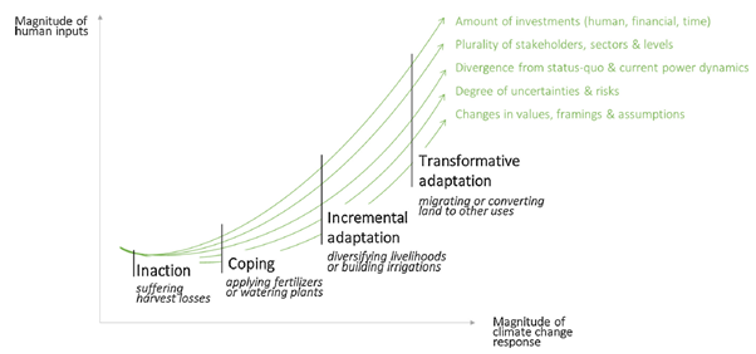
Coping strategies involve short-term, reactive measures to deal with immediate climate impacts. These are often temporary solutions that don’t address the root causes of vulnerability. A good example is using air conditioning during heatwaves without implementing urban heat island mitigation strategies.

Incremental adaptation involves gradual changes to existing systems and practices to reduce vulnerability or enhance resilience to climate change. These measures build upon current approaches and aim to maintain the essence of existing systems. For example, farmers switching to drought-resistant crop varieties.

Finally, transformative adaptation involves fundamental changes to the functioning of a system in response to actual or expected climate change impacts. These long-term measures often lead to new systems or ways of operating. One drastic case could be relocating entire communities from areas at high risk of sea-level rise.
.

Types of adaptation measures, Credits: Fedele et al. 2019

How can societies respond to the impacts of climate change? 3/4
Prev
How can societies respond to the impacts of climate change? Quiz
Next

coordinated by

CMCC – Fondazione Centro Euro – Mediterraneo sui Cambiamenti Climatici

Via Marco Biagi 5 – 73100 Lecce, Italy
Tel: +39 0832 1902411
© 2024 Agora. All rights reserved
Facebook X-twitter Linkedin Youtube Envelope

coordinated by

CMCC – Fondazione Centro Euro – Mediterraneo sui Cambiamenti Climatici

Via Marco Biagi 5 – 73100 Lecce, Italy
Tel: +39 0832 1902411
© 2024 Adaptation AGORA. All rights reserved
Facebook X-twitter Linkedin Youtube Envelope

Funded by the European Union. Views and opinions expressed are however those of the authors only and do not necessarily reflect those of the European Union or the European Commission. Neither the European Union nor the granting authority can be held responsible for them.

  • Terms of Use
  • Privacy Policy
  • Cookie Declaration

Funded by the European Union. Views and opinions expressed are however those of the authors only and do not necessarily reflect those of the European Union or the European Commission. Neither the European Union nor the granting authority can be held responsible for them.

  • Terms of Use
  • Privacy Policy
  • Cookie Declaration